Arnhem Coast
Bioregional description
This bioregion comprises a coastal strip extending from just east of Cobourg Peninsula to just north of the mouth of the Rose River in southeastern Arnhem Land, and including many offshore islands, most notably Groote Eylandt (and its satellites), the English Company and Wessel group, and the Crocodile Islands. Coastal vegetation includes well developed heathlands, mangroves and saline flats, with some floodplain and wetland areas, most notably the extensive paperbark forest and sedgelands of the Arafura Swamp. Coastal dune systems are unusually well developed on sections of Groote Eylandt and Cape Arnhem Peninsula. Rugged Cretaceous sandstone areas occur on Groote Eylandt and islands of the Wessel group. Tertiary laterites are extensive on the Gove Peninsula. Inland from the coast, the dominant vegetation type is eucalypt tall open forest, typically dominated by Darwin woollybutt (Eucalyptus miniata) and Darwin stringybark (E. tetrodonta), with smaller areas of monsoon rainforest and eucalypt woodlands. Five subregions have been identified.
Special values
This bioregion contains some of the most remote and intact large natural systems in Australia, including extensive mangrove, seasonally-inundated floodplains, perennial swamps, coastal dune systems, monsoon rainforests, and eucalypt tall open forests. There are many important breeding sites for marine turtles and colonial seabirds, and roosting and feeding sites for migratory shorebirds. The bioregion contains many islands whose isolation provides important refuge from processes which threaten mainland areas. At least 24 species listed as threatened at Territory and/or national level occur in the bioregion. These records include the only Territory occurrence of the golden bandicoot Isoodon auratus (on a single island), formerly abundant across much of Australia.
- Summary of overall condition and trend
The bioregion is generally in good condition, but this is being eroded by continuing increases in the number of feral animals (especially pigs, but also buffalo and cattle) and weeds, and broad-scale changes in fire regime. Major strip-mining ventures have localised impacts around Gove and on Groote Eylandt. All subregions are rated as continental stress class 5. - Summary of priority management/conservation priorities
There are no National Parks in this bioregion, however an IPA has recently been declared covering a small part of the NE Arnhem Land coastal area. There is much scope for increased collaborative conservation reservation in the bioregion, especially in the biologically important island groups. But at least equally important is the requirement for more resources and capacity building to encourage and allow Aboriginal owners to more effectively undertake conservation management (especially control of ferals and weeds, and reinstatement of more beneficial fire regimes) on their lands. - Wetlands
- Nationally important wetlands
This bioregion includes most of the Arafura Swamp (NT021), an extensive permanent wetland (wetland types B4, B14, B1, B2, B9 and B10). This swamp is significant as a breeding and refuge site for waterfowl and other wetland biota. Although in generally good condition, values are now degrading through the recent arrival of feral pigs and cane toads, localised planting of highly invasive exotic pasture grasses, and some incursions by livestock. Localised outbreaks of Mimosa pigra have been controlled to date, but the continuing arrival of propagules dispersed by waterfowl provide a continuing threat. The wetland is also highly susceptible to saltwater intrusion associated with global climate change and/or impacts of buffalo.
This bioregion also includes the Blyth-Cadell floodplain and Boucaut Bay system (NT022), a floodplain and adjacent coastal estuary (wetland types B4, A6, A8, A9 and A7), with similar condition, trends and threatening processes. A small portion of the Murgenella-Cooper floodplain system (NT028: wetland types B4, A8, A6, A9, A7, B1, B2 and B10) also occurs in this bioregion, again with similar condition, trends and threats.
- Other wetlands of subregional significance
Although not systematically assessed there are a series of dune lakes on Groote Eylandt, a permanent wetland at Jensen Bay on the Wessel Islands, and a series of swamps, seasonally inundated floodplains and river systems on the mainland of northern Arnhem Land.
- Nationally important wetlands
- Riparian zones
The mainland portion of the Arnhem Coast bioregion includes the lower reaches of some major river systems, including the Goyder, Blyth, Cadell, Goomadeer, Mann, Koolatong and Walker Rivers. Most riparian zones in this bioregion are in good condition, however this is generally declining because of damage associated with proliferation of feral pigs and buffalo, and invasion by some weed species. - Ecosystems at risk
Although not formally designated as threatened, the riparian areas, swamps and rainforest patches across most of the bioregion are suffering ongoing decline from a mixture of factors including feral animals, weeds and changed fire regimes. - Species at risk
The 24 threatened species comprise a mostly heterogeneous collection, other than six species of marine turtles, which are affected by global range factors (by-catch in commercial fisheries, pollution, hunting) and more localised factors (principally predation at nesting sites by people, feral pigs and dogs, and increased numbers of goannas). Most of the other species are affected by environmental change associated with altered fire regimes, feral animals and weeds.
Number of taxa in the Arnhem Coast bioregion listed as threatened at national and/or NT level (nb this table includes only species definitely recorded from the bioregion (rather than putative occurrences based on modelling) and presumed to be still extant in the bioregion).
| taxa | National | Northern Territory | ||
|---|---|---|---|---|
| endangered | vulnerable | endangered | vulnerable | |
| plants | 0 | 1 | 0 | 7 |
| reptiles | 2 | 4 | 0 | 1 |
| birds | 1 | 3 | 1 | 2 |
| mammals | 0 | 4 | 1 | 2 |
There is also some evidence that there is broad scale decline affecting at least some groups of mammals and birds in this bioregion, in addition to those species currently listed as threatened.
- Other flora values for eucalypts and acacias
- Endemism
Four endemic Acacia and eucalypt species occur in the Arnhem Coast subregions: Acacia dunlopii and Eucalyptus sp. (Maningrida K.Hill 3984) in ARC2; A. sp. (Gove D2219-2) and E. sp. (Gan Gan K.Hill 3945) in ARC3. There are no reliable data on abundance, condition or trends, but the Acacia species may be affected detrimentally by altered fire regimes.
- Richness
The Arnhem Coast subregions have only moderate species tallies for eucalypts (14-41 spp.) and acacias (7-34 spp.).
- Endemism
- Birds
There was insufficient survey effort in the two Atlas periods to confidently provide any assessment of recent changes in the status of birds in this bioregion. There is no indication in the broader literature of any pronounced changes. - Mammals
The mammal fauna of this bioregion has generally been fairly resilient. Of 55 native species present, 4 have declined and 51 are stable.
Management Responses
- Reserve consolidation
There is scope for additional cooperatively managed conservation reserves of IPAs centred on sites with high conservation values, such as the Wessel Islands, parts of Groote Eylandt, and the Arafura Swamp. - Off park conservation for species and ecosystem recovery
Existing recovery plans for marine turtles (and codes of practice in the commercial fishing industry to limit incidental by-catch) provide some broad-brush protective management for this group of threatened species. The Northern Territory also has a Strategy for conservation of biological diversity of wetlands, which provides some management goals and actions for wetlands across tenures. - Integrated NRM
As with many other bioregions in northern and central Australia, the most important priority for biodiversity conservation and management is the provision of resources and capacity building to encourage and allow Aboriginal owners to more effectively manage their lands (and particularly to combat weeds and feral animals, and to reinstitute more favourable burning regimes), where possible in collaboration with government conservation agencies. In this bioregion, there are several examples of Indigenous Community Ranger corps undertaking such conservation management, most notably the Dhimurru Aboriginal Land Management Corporation on the north-east Arnhem Land mainland and the Djelk rangers of Bawinanga Aboriginal Corporation in the Maningrida area.
Currently there is little monitoring of threats or their impacts. The most notable exception is the now routine interpretation of satellite imagery to map and analyse fire patterns.
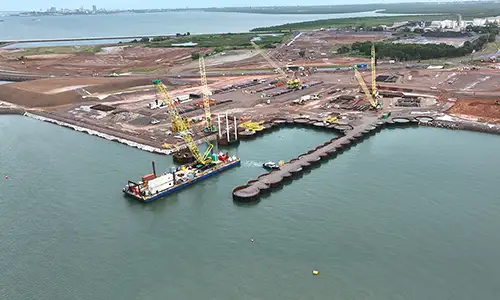
At a more localised level, there is some conservation management associated with rehabilitation of the extensive strip-mined lands at Gove and on Groote Eylandt.
Further Information and Gaps
- Major data gaps and research priorities for bioregion
There has been no systematic survey of conservation values for the large Groote Eylandt, which comprises almost all of one of this area's subregions. As with other "remote" subregions, there is also a need for monitoring programs on the abundance and distribution of feral animals and weeds, and of the native biota likely to be affected by these. Further research is also needed on the development of cost-effective mechanisms for managing these threats.
Management would also benefit from more detailed environmental mapping, in particular vegetation mapping at the scale of 1:250,000 or better.
Much of the traditional ecological knowledge possessed by the Aboriginal landowners of this bioregion remains undocumented, and parts of this knowledge are suffering decay through loss of traditional elders. It is important that this knowledge be appropriately recorded and maintained. - Other information